K-Nearest Neighbors Classification
Machine Learning
AI Engineering
K-Nearest Neighbors for Classification Tasks
Estimated reading time: ~10 minutes
K-Nearest Neighbors Classification
Objectives
- Use K-Nearest Neighbors to classify data
- Apply KNN classifier on a real world data set
Introduction
This article demonstrates how to use K-Nearest Neighbors (KNN) to classify customer data, including model training, evaluation, and hyperparameter tuning.
Import the libraries
import numpy as np
import matplotlib.pyplot as plt
import pandas as pd
import seaborn as sns
from sklearn.preprocessing import StandardScaler
from sklearn.model_selection import train_test_split
from sklearn.neighbors import KNeighborsClassifier
from sklearn.metrics import accuracy_score
%matplotlib inline
Load Data
df = pd.read_csv('https://cf-courses-data.s3.us.cloud-object-storage.appdomain.cloud/IBMDeveloperSkillsNetwork-ML0101EN-SkillsNetwork/labs/Module%203/data/teleCust1000t.csv')
df.head()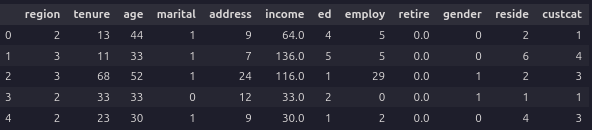
Data Visualization and Analysis
df['custcat'].value_counts()
correlation_matrix = df.corr()
plt.figure(figsize=(10, 8))
sns.heatmap(correlation_matrix, annot=True, cmap='coolwarm', fmt='.2f', linewidths=0.5)
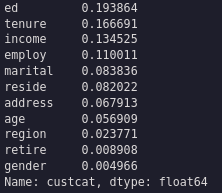
correlation_values = abs(df.corr()['custcat'].drop('custcat')).sort_values(ascending=False)
correlation_values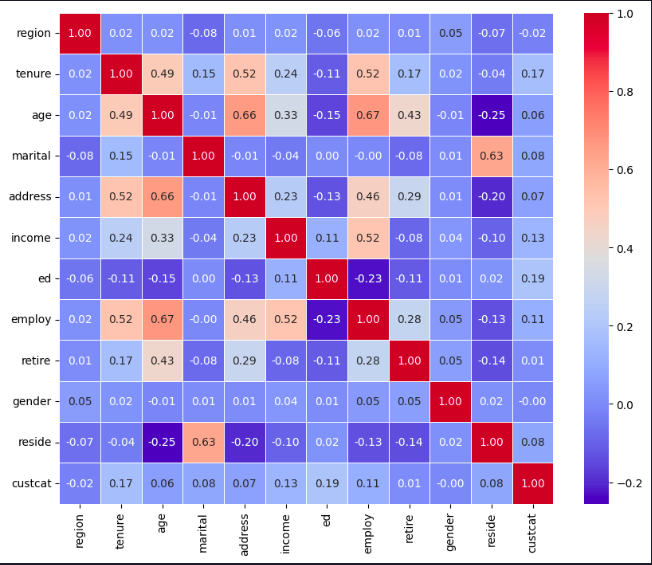
Prepare Data
X = df.drop('custcat',axis=1)
y = df['custcat']
X_norm = StandardScaler().fit_transform(X)
X_train, X_test, y_train, y_test = train_test_split(X_norm, y, test_size=0.2, random_state=4)
KNN Classification
k = 3
knn_classifier = KNeighborsClassifier(n_neighbors=k)
knn_model = knn_classifier.fit(X_train,y_train)
yhat = knn_model.predict(X_test)
print("Test set Accuracy: ", accuracy_score(y_test, yhat))
Test set Accuracy: 0.315
Hyperparameter Tuning
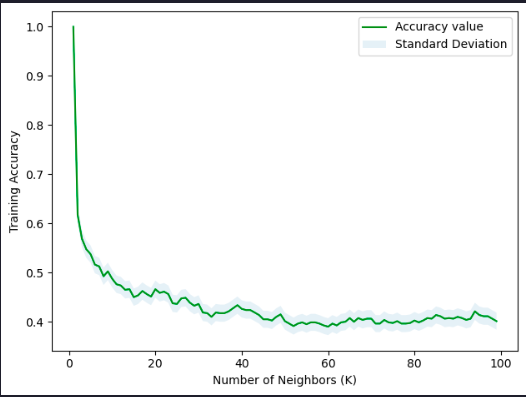
# Plot training accuracy for Ks = 100
Ks = 100
acc = np.zeros((Ks-1))
std_acc = np.zeros((Ks-1))
for n in range(1, Ks):
    knn_model_n = KNeighborsClassifier(n_neighbors=n).fit(X_train, y_train)
    yhat_train = knn_model_n.predict(X_train)
    acc[n-1] = accuracy_score(y_train, yhat_train)
    std_acc[n-1] = np.std(yhat_train == y_train) / np.sqrt(yhat_train.shape[0])

print( "The best accuracy was with", acc.max(), "with k =", acc.argmax()+1)

plt.plot(range(1, Ks), acc, 'g')
plt.fill_between(range(1, Ks), acc - 1 * std_acc, acc + 1 * std_acc, alpha=0.10)
plt.legend(('Accuracy value', 'Standard Deviation'))
plt.ylabel('Training Accuracy')
plt.xlabel('Number of Neighbors (K)')
plt.tight_layout()
plt.show()
The best accuracy was with 0.34 with k = 9
Summary
This article demonstrated how to use K-Nearest Neighbors for classification, including model training, evaluation, and hyperparameter tuning.